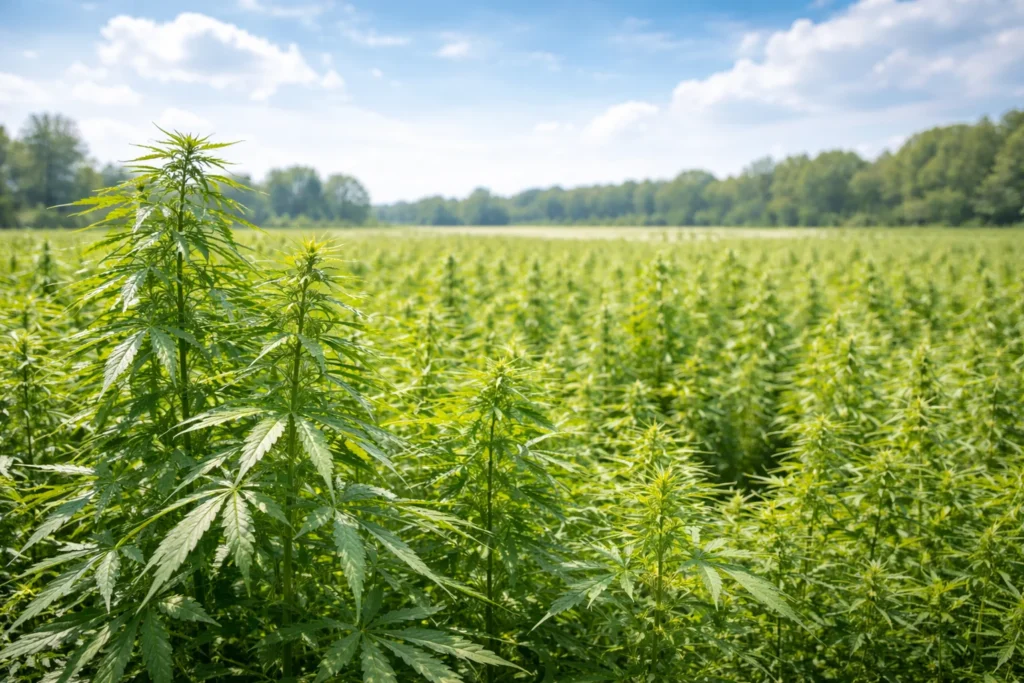
Most paper starts as a tree that took decades to grow. It is used for a few minutes, and with luck it is recycled a couple of times before the fibers give out. Hemp paper starts somewhere very different: a field crop that is ready in a single season, and a fiber that is stronger from the start.
Here is what that difference looks like, using the figures from the Hemp Heritage™ spec sheet.
A crop that is ready in four months
Hemp goes from seed to harvest in about four months. Softwood trees grown for pulp take 8 to 12 years, and hardwoods take 20 to 80. A field of hemp can be planted, harvested, and planted again many times over before a single stand of trees is ready to cut.
More paper from the same land
Because hemp grows so fast and so densely, the same acre of land yields about four times more paper than trees do. Less land for the same number of sheets means more forest left standing.
A stronger sheet that lasts longer
Paper is held together by cellulose. Hemp paper is about 85% cellulose, against roughly 30% for tree paper. More cellulose means longer fibers, and longer fibers make a stronger sheet.
That strength shows up in two ways. First, hemp paper can be recycled about seven times before the fibers wear out, compared with three for tree paper. Second, it ages well. Hemp's long fibers resist sunlight, heat, and damp, while the short, acidic fibers in tree paper break down faster. Hemp Heritage paper is acid-free, chlorine-free, and naturally buffered, which is why it is archival quality.
| Hemp Heritage | Tree paper | |
|---|---|---|
| Growth cycle | 4 months | 8 to 12 years for softwood, 20 to 80 for hardwood |
| Paper per acre | 4 times more | Baseline |
| Cellulose content | 85% | 30% |
| Times recyclable | 7 | 3 |
| Aging | Resists sunlight, heat, and damp | Short, acidic fibers degrade faster |
An old idea, not a new one
Hemp is not a new papermaking fiber. It has been used to make paper for nearly 2,000 years, and for most of that time paper was made from plant fibers such as hemp and linen rather than wood. Wood pulp only became the standard in the 1800s, when demand for cheap paper took off. Choosing hemp paper today is less an experiment than a return to what worked.
How Hemp Heritage paper is made
Every Hemp Heritage sheet is 25% North American hemp and 75% post-consumer recycled fiber. The hemp brings the long, strong fibers. The recycled fiber gives paper that has already been used another life.
- No bleaches or dyes. The off-white color is the paper itself, and the dark flecks are real hemp fiber.
- No virgin wood pulp. Nothing in the sheet comes from a freshly cut tree.
- Made close to home. The hemp is grown on North American farms and the paper is milled on hydroelectric power, so the supply chain stays local.
- Bio-based from start to finish. The paper is biodegradable and compostable at the end of its life, with no plastic coatings.
What it is like to use
Hemp Heritage paper has a vellum antique finish with a gentle tooth. It comes in two text weights and two cover weights, from a 60# text sheet for letterhead to a 110# cover for cards and packaging. The text weights are smooth enough for both inkjet and laser printers.
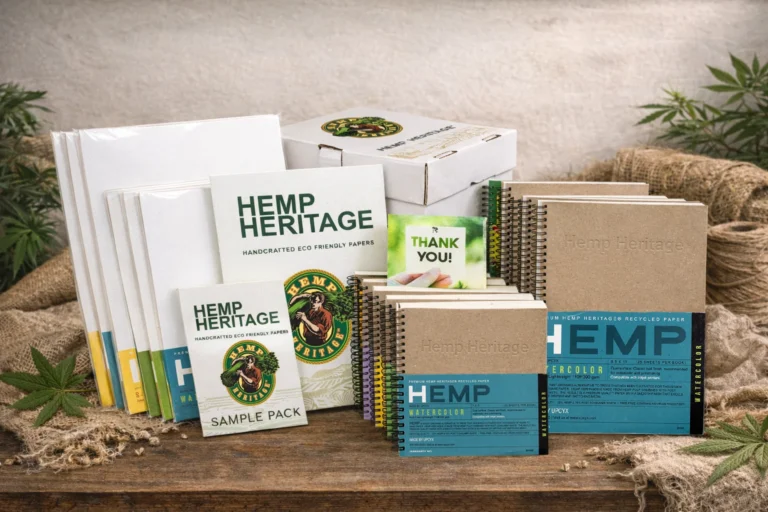
In practice that means you can swap it in for the paper you already use: letterhead, envelopes, business cards, labels, notebooks, and sketchbooks.
Where to start
- For the office: the Mini Ream or Paper by the Ream, with matching #10 Business Envelopes.
- For writing and drawing: the journals and sketchbooks.
- For artists: sketch, drawing, and watercolour paper in loose-sheet art packs.
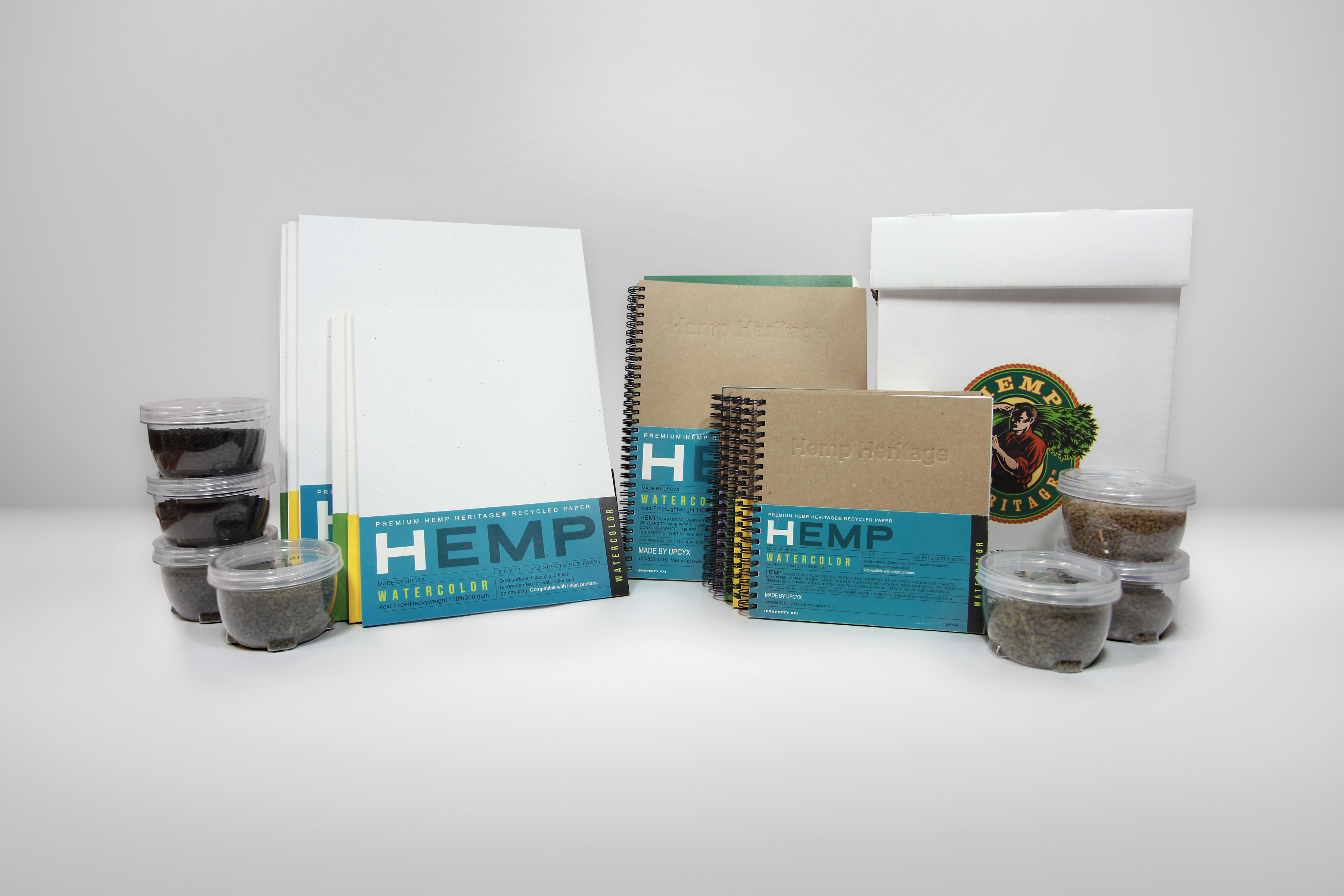
- To see everything: the Sample Box has one of every paper and book.
Want the specs for each paper? Read The Artist's Guide to Hemp Heritage Paper.
Made on hemp paper
Journals, stationery, and fine art paper made from 25% hemp and 75% post-consumer recycled fiber.