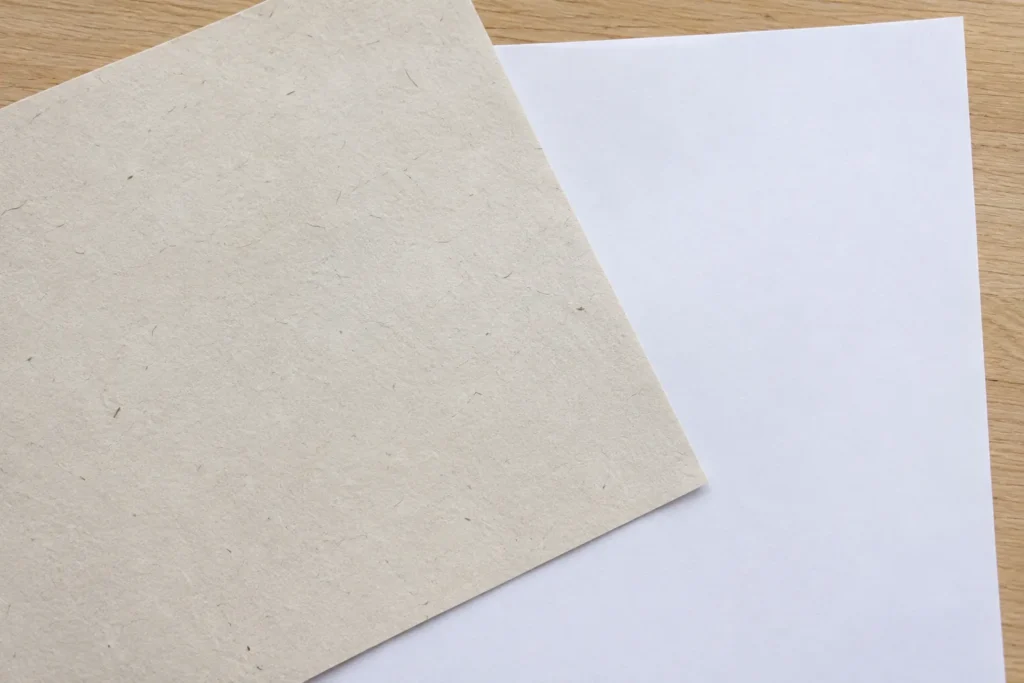
Hemp paper and tree paper are both sheets of plant fibre, and you can write, draw and print on either one. The differences are where the fibre comes from, how the finished sheet looks and feels, and what you pay for it. This is the practical comparison. If you want the growing and yield figures, they are on our hemp vs tree paper numbers page.
The short version
| Hemp paper (ours) | Ordinary tree paper | |
|---|---|---|
| Fibre | 25% hemp, 75% post-consumer recycled | Wood pulp, usually new |
| The crop | An annual field crop, harvested about four months after planting | Trees grown for years before cutting |
| Colour | Natural off-white with small dark flecks | Bleached bright white |
| Surface | Soft, with a slight tooth | Smooth |
| Acid-free | Yes, tested at pH 8.2 to 8.4 | Depends on the brand |
| Printers | Inkjet and laser | Inkjet and laser |
| Price | Higher | Low |
| Where you find it | Specialty suppliers | Everywhere |
Where the fibre comes from
Tree paper starts with wood chips. The wood is cooked to free the cellulose fibres from lignin, the natural glue that holds a tree together, and the pulp is then bleached white.
Hemp paper starts with the stalk of the hemp plant. The useful fibres run along the outside of the stalk. They are long, and they hold less lignin than wood does, so they need less work to turn into pulp.
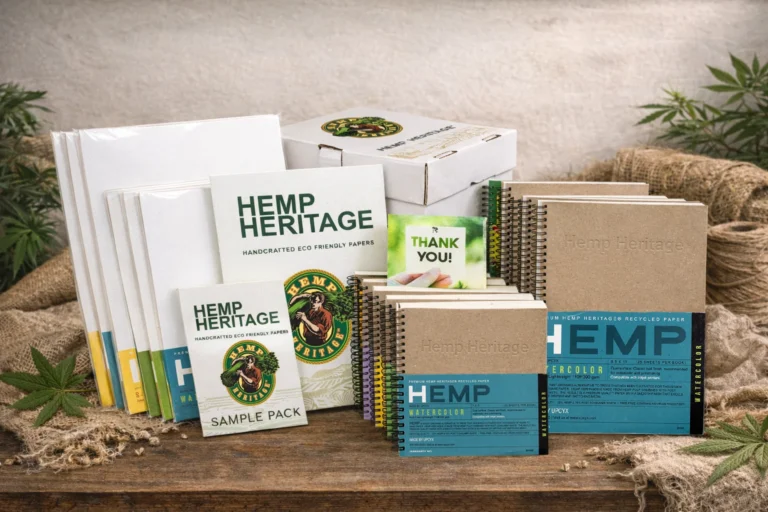
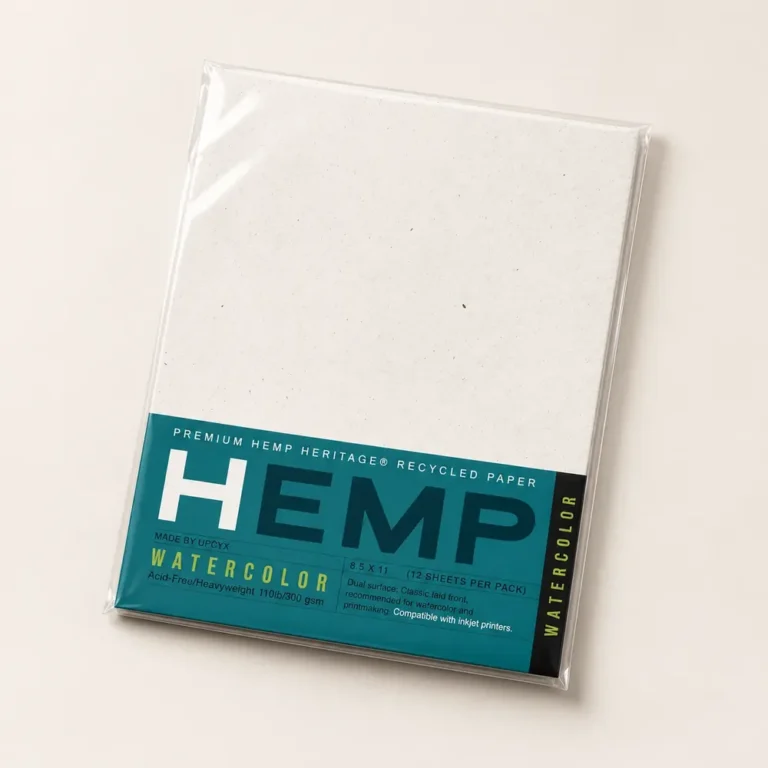
Most hemp paper is a blend, and ours is too. Hemp Heritage is 25% hemp and 75% post-consumer recycled fibre, with no virgin wood pulp. The recycled part was tree paper once. The difference is that no new tree was cut for it.
How the two sheets look and feel
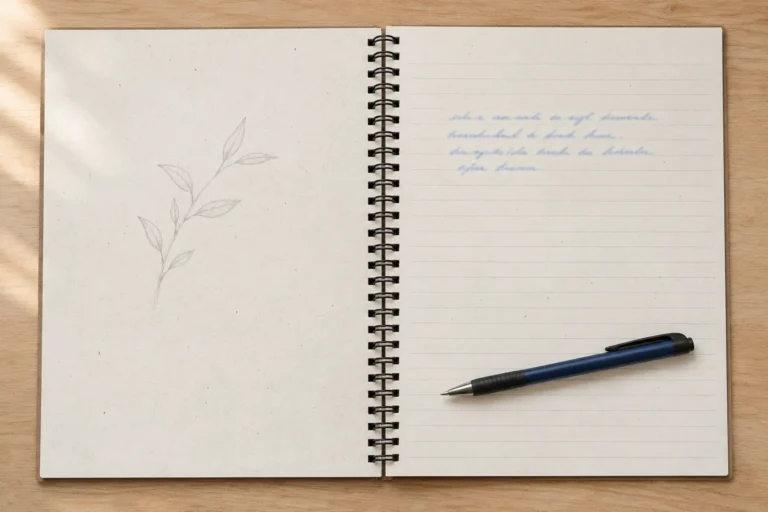
Put them side by side and you can tell them apart at a glance. Copy paper is bright white and flat. Hemp Heritage paper is a natural off-white, because nothing in it is bleached or dyed, and it carries small dark flecks of hemp fibre.
Run a finger across each. Copy paper is slick. Our paper has a vellum antique finish, which means a soft surface with a little grip. Pencil and charcoal like that. A fine-point pen works on both.
Where tree paper wins
- Price. Wood pulp is made on an enormous scale, and nothing else comes close on cost.
- Whiteness. If colours must print exactly as they look on screen, a bright white sheet is the safer base.
- Sameness. Every ream of copy paper matches the last one. Our paper varies a little from batch to batch, because the colour is the colour of the pulp.
- Availability. Any office supply store has it today.
Where hemp paper wins
- The sheet is the message. People notice it when they pick it up. That matters for letterhead, menus, invitations, packaging and art.
- No new wood. Every fibre is either hemp or paper that has already been used once.
- Nothing added for colour. No bleach and no dye.
- It keeps. The paper is acid-free, so a journal or a drawing will not yellow and turn brittle the way acidic paper does.
Which should you use?
Use tree paper for the print-and-recycle work: drafts, internal reports, anything read once.
Use hemp paper for anything a person will hold and keep: a letter, a sketchbook, a wedding invitation, a product label, a gift.
Most offices and studios end up with both.
Keep reading
- Why don't we use hemp for paper? explains why hemp paper is still rare.
- Hemp paper or recycled paper covers the other common comparison.
- Want to try it in your own printer? Start with the Mini Hemp Paper Ream.
Made on hemp paper
Journals, stationery, and fine art paper made from 25% hemp and 75% post-consumer recycled fiber.